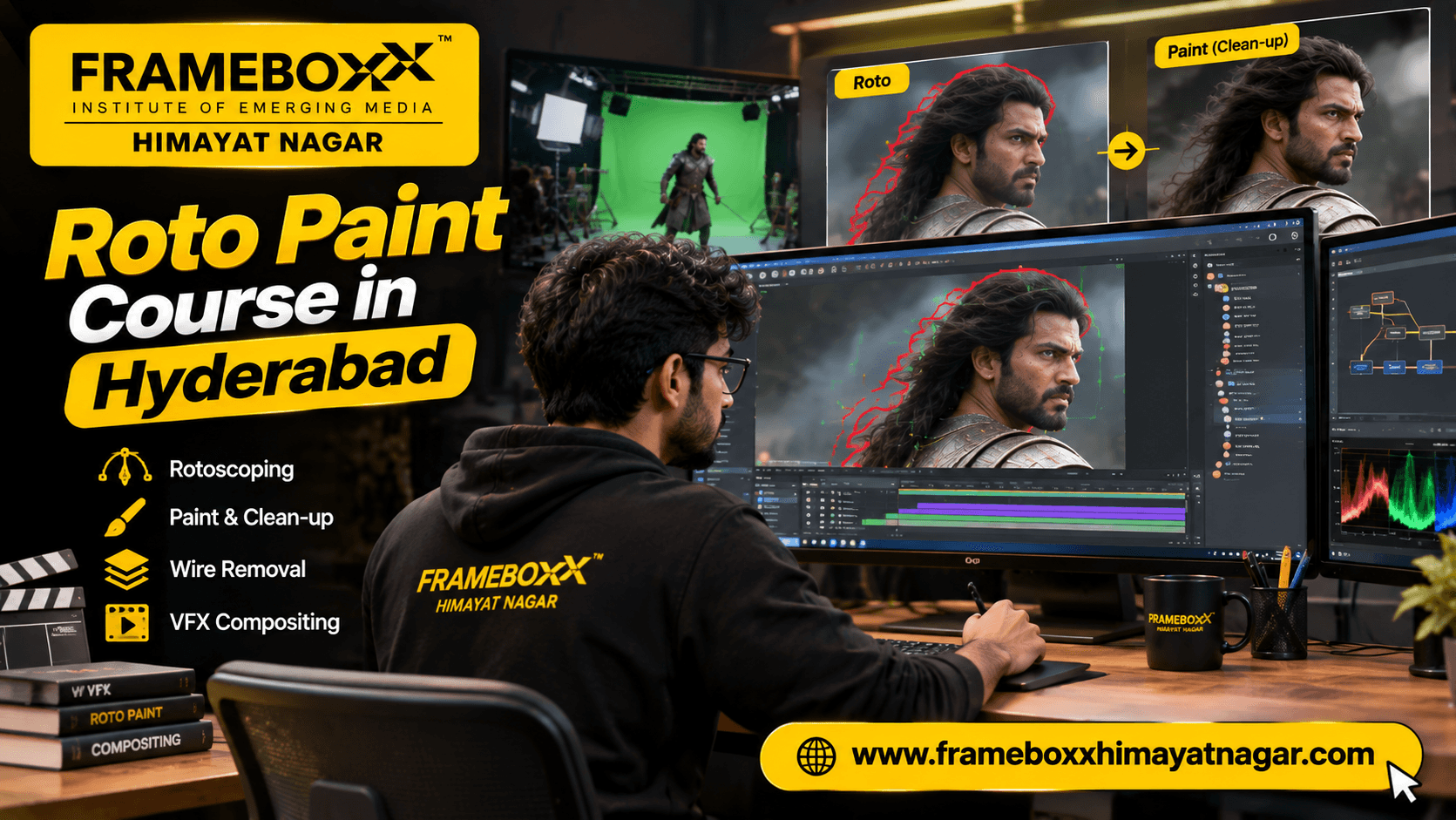
Interested in working on the detailed visual-effects tasks that make film and video shots ready for compositing? Roto and paint are two important parts of the VFX post-production process. They help artists isolate moving subjects, remove unwanted elements and prepare clean image details for the final shot.
A Roto Paint Course in Hyderabad is relevant for students who want to understand these production tasks and develop practical VFX skills. Rotoscoping involves creating mattes around moving subjects or objects across video frames. Paint work involves removing unwanted image elements, repairing damaged areas and reconstructing details so that the shot looks natural.
At Frameboxx Himayatnagar, students can explore the institute's broader Animation & VFX learning options and ask about the current curriculum related to rotoscoping, paint and compositing. Before enrolling, confirm whether a dedicated roto paint module or specialisation is available, which software is taught and what practical assignments are included.
What Is Roto and Paint in VFX?
Roto and paint are related but separate VFX tasks that help prepare footage for further post-production.
What Is Rotoscoping?
Rotoscoping, commonly called roto, is the process of creating a matte or shape around a subject or object in moving footage.
The matte helps separate the selected subject from the rest of the image. This allows compositors to make changes to the background, combine elements or apply effects to specific parts of a shot.
For example, imagine a film scene in which an actor walks in front of a busy street. A roto artist may create a precise matte around the actor so that the actor can be separated from the original background.
Rotoscoping may involve:
- Creating shapes around subjects and objects
- Following movement from frame to frame
- Refining edges around hair, clothing and fine details
- Managing motion blur and changing silhouettes
- Maintaining consistent mattes across a shot
- Checking the result during playback
The quality of a roto matte matters because inaccurate edges can create visible errors in the final composite.
What Is Paint in VFX?
Paint work involves removing or repairing unwanted visual information in footage.
A paint artist may remove objects, wires, rigs, markers, unwanted reflections or other distractions from a shot. The artist may need to reconstruct the background using nearby image information, clean frames or suitable reference material.
Typical paint tasks include:
- Removing unwanted objects
- Cleaning tracking markers
- Removing visible wires and rigging elements
- Repairing damaged or missing image areas
- Creating clean plates
- Reconstructing background details
- Fixing small image imperfections
For example, if a camera rig or unwanted object appears in a film shot, a paint artist may remove it and rebuild the affected area so the result looks consistent with the surrounding footage.
Difference Between Roto and Paint
Both tasks contribute to VFX shot preparation, but they solve different problems.
| Rotoscoping | Paint |
|---|---|
| Separates a subject or object from the background | Removes or repairs unwanted image details |
| Creates mattes and shapes | Reconstructs or cleans image areas |
| Follows movement across frames | Maintains visual consistency across repaired frames |
| Helps isolate elements for compositing | Helps produce clean image plates and repaired footage |
| Focuses on accurate edges and motion | Focuses on seamless image restoration |
Simple example: If an actor needs to be separated from a background, roto creates the matte. If an unwanted object needs to disappear from the shot, paint work may be used to remove it.
Some shots require both techniques.
Why Are Roto and Paint Important in VFX Production?
A VFX shot often contains several layers of work. Roto and paint help prepare the footage so that compositors can make controlled changes without damaging the visual continuity of the shot.
These techniques are used in workflows involving:
- Film and television visual effects
- Streaming content
- Commercials and promotional videos
- Background replacement
- Object removal
- Wire and rig removal
- Image repair
- Digital compositing
The exact work depends on the shot, production requirements and complexity of the visual effect.
What Does a Roto Paint Artist Do?
A roto paint artist works on individual shots and prepares image elements for the wider post-production pipeline.
The work requires patience, observation, precision and an understanding of how images change over time.
A typical workflow may include:
1. Shot Review and Reference Checking
The artist studies the footage to understand the required task.
They identify the subject, movement, camera behaviour, difficult edges and areas that need to be removed or repaired.
2. Roto Shape Creation
For rotoscoping, the artist creates shapes around the subject or object that needs to be isolated.
The shape must follow the visible boundary as accurately as possible.
3. Tracking and Frame-by-Frame Refinement
The subject may move, rotate, become partially hidden or change shape during the shot.
The artist adjusts the matte over time and checks whether it remains attached to the correct image area.
Automatic tracking or interpolation can assist with parts of the process, but difficult movement and changing edges still require careful review.
4. Edge Refinement
A matte that looks acceptable on one frame may show problems during playback.
The artist checks areas such as:
- Hair and fine strands
- Motion-blurred edges
- Transparent or semi-transparent details
- Fast-moving limbs
- Overlapping objects
- Soft edges and shadows
The goal is to create a matte that works consistently across the shot.
5. Paint and Image Repair
For paint tasks, the artist identifies unwanted image details and plans how to remove them.
Depending on the shot, the repair may use nearby pixels, reference frames, tracked patches or other image-reconstruction techniques.
6. Quality Checking and Handoff
The artist reviews the result at different playback speeds and checks for flicker, edge chatter, visible patches, inconsistent details and other errors.
The finished work is then prepared for the next stage of the production pipeline.
What Should You Learn in Roto Paint Training?
A useful learning pathway should cover both the artistic judgement and technical processes behind roto and paint work.
The following is a recommended subject framework for evaluating a programme. It is not a confirmed Frameboxx Himayatnagar syllabus. Ask the centre for its current module list before admission.
Rotoscoping Fundamentals
Understand how mattes, shapes and masks are used to isolate objects in moving footage.
Topics to practise may include:
- Shape creation and editing
- Bezier curves and control points
- Keyframes and animation
- Shape organisation
- Tracking-assisted workflows
- Matte refinement
- Motion blur and edge handling
- Frame-by-frame quality checking
Paint and Clean Plate Fundamentals
Learn how to repair image areas while maintaining continuity with the surrounding footage.
Useful topics include:
- Object removal
- Wire and marker removal
- Clean plate preparation
- Patch creation
- Clone and paint techniques
- Image reconstruction
- Tracking paint elements
- Checking repairs across frames
VFX Workflow Understanding
Roto and paint do not work in isolation. Artists need to understand how their outputs are used in compositing.
A learning pathway should explain:
- How mattes support compositing
- How clean plates are used
- Why accurate edges matter
- How shot requirements affect the workflow
- How to organise and hand off work
- How to review feedback and correct errors
Quality Control
A technically completed shot is not necessarily a good shot.
Learners should practise identifying:
- Edge chatter
- Matte gaps
- Unwanted holes
- Flickering paint patches
- Sliding repairs
- Inconsistent edges
- Visible colour or texture differences
Quality checking is an important part of developing reliable VFX work.
Which Software Is Used for Roto and Paint?
Roto and paint workflows are supported by specialised compositing and VFX applications. The software used depends on the production pipeline and the institute's actual curriculum.
Foundry Nuke
Nuke is a node-based compositing application used in visual-effects production. Its toolset includes workflows for rotoscoping, paint, tracking and compositing.
For a learner, the important objective is not just learning where tools are located. It is understanding how shapes, mattes, tracking information and paint operations work together within a shot.
Official resource: https://www.foundry.com/products/nuke-family/nuke
Other VFX Applications
Different studios and production teams may use different applications and workflows. Some tools may be used for specialised tasks, while others are part of a broader compositing pipeline.
Before enrolling, ask the institute:
- Which software will be taught?
- Will students practise both roto and paint?
- Will assignments use moving footage?
- Will students learn tracking-assisted techniques?
- Will the course explain how work is handed off for compositing?
Software clarification: Mentioning Nuke here explains a recognised VFX application; it does not confirm that Frameboxx Himayatnagar currently teaches Nuke or includes a dedicated roto paint module.
Practical Projects to Build Roto Paint Skills
A strong learning portfolio should show how you handle different footage challenges. It should demonstrate both the final output and your understanding of the process.
Project 1: Basic Object Rotoscoping
Create a matte around a clearly visible moving object.
Focus on shape placement, movement, edge accuracy and consistency across frames.
Project 2: Human Subject Rotoscoping
Isolate a person walking, running or moving through a scene.
Practise handling changing body positions, overlapping limbs and difficult edges.
Project 3: Hair and Motion Blur Refinement
Work on footage with fine hair details or motion-blurred edges.
This helps develop observation and matte-refinement skills beyond simple geometric shapes.
Project 4: Wire or Marker Removal
Remove a visible wire or tracking marker from footage.
Pay attention to background texture, surrounding movement and the consistency of the repaired area.
Project 5: Clean Plate Creation
Prepare a clean version of a shot by removing selected unwanted elements.
The repaired image should remain visually consistent when played back.
Project 6: Combined Roto and Paint Shot
Choose a shot that requires both subject isolation and image repair.
Show the original footage, roto matte, paint result and final composite-ready output.
For each project, keep a breakdown showing the original frame, work-in-progress frames and final result. This makes it easier for someone reviewing your portfolio to understand what you actually contributed.
Skills Required to Become a Roto Paint Artist
Roto and paint work requires a combination of technical understanding and visual attention.
Important skills include:
Attention to detail: Small errors around edges or repaired areas can become visible during playback.
Patience and consistency: Some shots require detailed adjustments across many frames.
Understanding of motion: Artists need to recognise how objects move, change shape and interact with the camera.
Observation: Identifying edge problems, texture differences and image inconsistencies is essential.
Visual judgement: Paint work requires an understanding of lighting, perspective, colour and surrounding image detail.
Problem-solving: Every shot is different. An approach that works for one frame may not work for the entire sequence.
You do not need to begin as an expert. However, a willingness to practise carefully and review your work is important.
Roto Paint vs Compositing: What Is the Difference?
Roto, paint and compositing are connected parts of the VFX pipeline, but each has a different purpose.
| Roto and Paint | Compositing |
|---|---|
| Creates mattes and repairs image areas | Combines multiple visual elements |
| Isolates subjects and removes unwanted details | Integrates foregrounds, backgrounds and effects |
| Prepares footage for further work | Builds the final combined shot |
| Focuses on edge accuracy and image restoration | Focuses on integration, lighting, colour and visual consistency |
For example, a roto artist may isolate an actor, a paint artist may remove an unwanted object, and a compositor may combine the actor with a replacement background.
Understanding this relationship helps learners see where their work fits into the wider VFX production process.
Career Opportunities Related to Roto and Paint
Roto and paint skills can be relevant to different areas of post-production. The roles available depend on an individual's skills, experience, portfolio and the requirements of the production team.
Related roles may include:
| Role | Typical responsibility |
|---|---|
| Roto Artist | Creating mattes to isolate subjects and objects |
| Paint Artist | Removing unwanted elements and repairing image areas |
| Roto Paint Artist | Handling both rotoscoping and paint tasks |
| Compositing Artist | Combining visual elements into a finished shot |
| VFX Artist | Working on different stages of visual-effects production |
Learning roto and paint can help build a foundation for understanding compositing workflows. Progression into other roles generally requires additional skills and relevant project experience.
Completing a course alone does not guarantee employment, a particular salary or placement. A focused portfolio and the ability to complete production-style assignments are important parts of career preparation.
How to Choose a Roto Paint Course in Hyderabad
Before selecting an institute, check whether the training covers actual shot work rather than only software demonstrations.
Use this checklist when comparing programmes:
- Roto coverage: Does the curriculum include shape creation, animation, tracking and matte refinement?
- Paint coverage: Does it teach object removal, clean plates, patching and image repair?
- Footage practice: Will students work with moving footage rather than only still images?
- Difficult shots: Are hair, motion blur, fast movement and overlapping objects covered?
- Software: Which compositing or VFX application is used?
- Feedback: Will students receive corrections on edge quality and paint consistency?
- Projects: Will learners complete individual roto and paint assignments?
- Portfolio: Can students present original footage, breakdowns and final results?
- Course details: What are the current fees, duration and eligibility requirements?
- Career guidance: What support is available for portfolio development and career preparation?
Ask to see examples of relevant student work, where available. A general VFX showreel may not demonstrate the quality of roto and paint training specifically.
Explore VFX Learning Options at Frameboxx Himayatnagar
Choosing a VFX course is easier when you understand the subjects, software and practical work included in the programme.
Frameboxx Himayatnagar's public course information lists broader Animation & VFX and Gaming & Interactive learning categories. Students interested in rotoscoping and paint can contact the centre to understand which current programme or module is relevant to their goals.
Before making an admission decision, ask:
- Is roto and paint included in the current VFX curriculum?
- Is there a dedicated roto paint training module?
- Which software applications are taught?
- Will students work on live-action footage?
- Are object removal and clean plate assignments included?
- Is compositing workflow also covered?
- What are the current fees, duration and eligibility criteria?
- What portfolio and career guidance is available?
Explore the official information:
Confirm the exact course availability, curriculum and admission details directly with the centre.
Start Your VFX Learning Journey in Hyderabad
Roto and paint are detail-oriented parts of visual-effects production. Learning them involves more than drawing shapes or removing objects: artists must understand movement, edges, image reconstruction and the requirements of the final shot.
If you are searching for a Roto Paint Course in Hyderabad, compare the practical curriculum, software, footage assignments and portfolio outcomes before enrolling.
Explore the available programmes at Frameboxx Himayatnagar and ask the counselling team whether its current Animation & VFX curriculum includes dedicated rotoscoping and paint training.
Request the latest course information, understand the learning pathway and choose a programme that matches your VFX career interests.