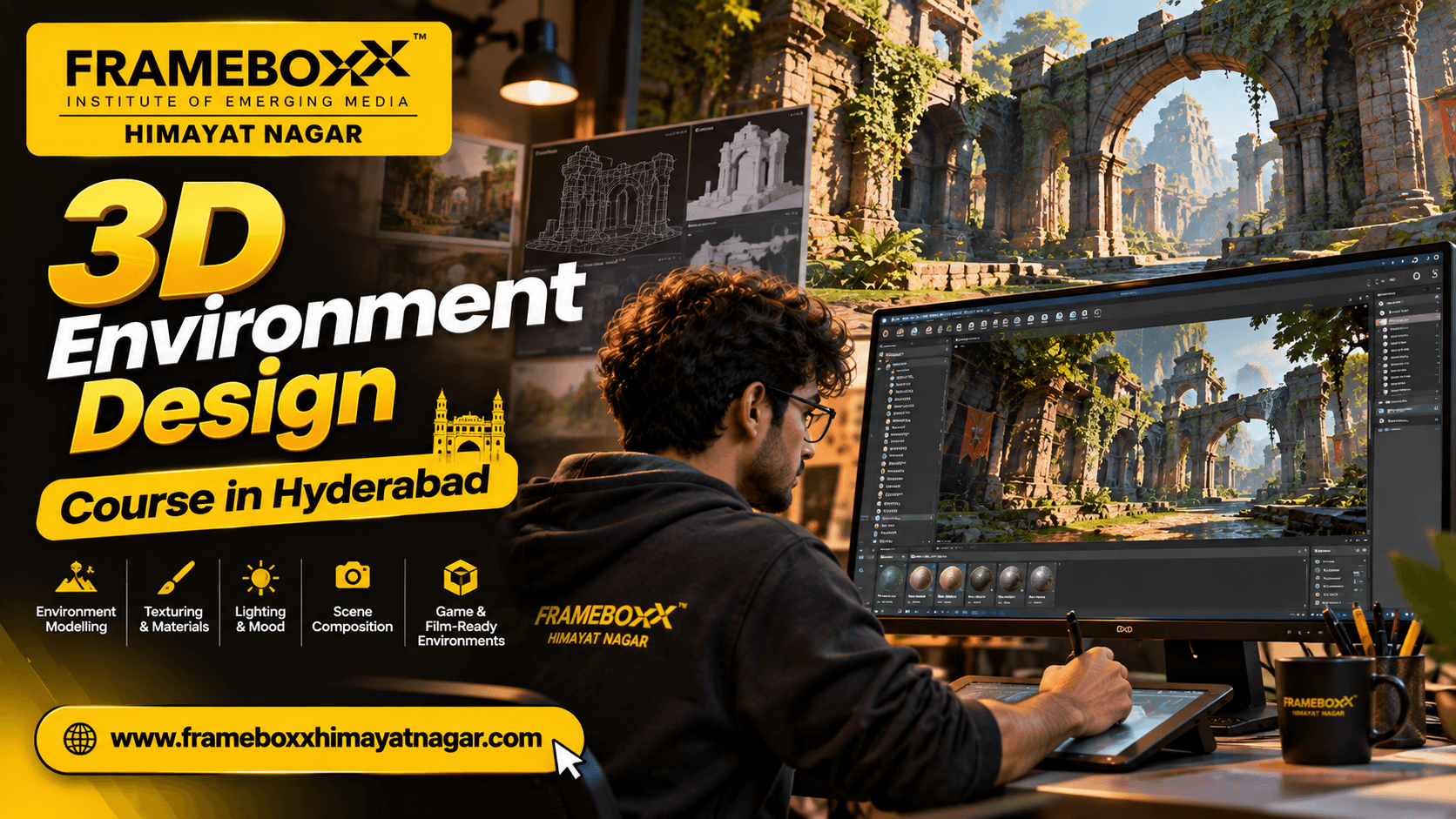
Want to create detailed 3D worlds for video games, animated films or visual effects projects? 3D environment design is the process of building the places where digital stories and experiences happen — from streets, buildings and forests to futuristic cities, fantasy landscapes and interactive game levels.
A 3D environment design course in Hyderabad can help you understand how these environments are planned, modelled, textured, lit and presented. The important thing is to learn more than software commands: you need to understand composition, scale, materials, visual storytelling and how individual assets work together to form a believable scene.
At Frameboxx Himayatnagar, students can explore the institute's broader Animation, VFX and Gaming learning pathways and enquire about the current curriculum relevant to 3D environment art. Before enrolling, confirm whether a dedicated environment-design specialisation is available and which tools and projects are included.
What Is 3D Environment Design?
3D environment design is the creation of digital spaces using three-dimensional objects, surfaces, materials, lighting and visual composition.
A 3D environment artist creates the surroundings that support a scene, film sequence or game experience. These surroundings may include natural landscapes, buildings, roads, furniture, vegetation, terrain, interior spaces and background elements.
For example, consider a video game level set in an abandoned city. The environment artist may need to create:
- Buildings with damaged walls and rooftops
- Roads, pavements and street furniture
- Broken vehicles and scattered objects
- Trees, plants and environmental details
- Surface materials such as concrete, glass, metal and wood
- Lighting that establishes the mood and time of day
Each element contributes to the visual identity of the world.
In simple terms: 3D environment design combines modelling, texturing, lighting, composition and world-building to create complete digital locations.
What Does a 3D Environment Artist Actually Do?
A 3D environment artist turns a visual idea or reference into a finished digital space.
The work generally moves through a series of connected stages:
1. Research and Reference Collection
Before creating a scene, artists study the location, subject and visual style they want to reproduce.
References may include photographs, architectural drawings, landscape images, colour palettes, material samples and concept art.
For example, an artist creating a traditional Indian marketplace may study shopfronts, signage, street layouts, building materials, lighting conditions and everyday objects.
The objective is to make the environment visually convincing rather than simply filling a scene with random 3D objects.
2. Environment Blockout
A blockout is a simplified version of the environment created using basic shapes.
At this stage, the artist focuses on:
- Overall layout
- Object placement
- Scale and proportions
- Camera position
- Scene composition
- Movement and navigation, where relevant
A good blockout helps identify design problems before time is spent creating detailed assets.
3. 3D Modelling
Modelling gives the environment its physical structure.
Artists create objects such as buildings, walls, doors, windows, furniture, rocks, bridges, roads and decorative elements.
The modelling approach depends on the project. A cinematic environment may prioritise close-up detail, while a real-time game environment must also consider performance and asset efficiency.
4. UV Mapping and Texturing
A model needs appropriate surface details to look convincing.
UV mapping prepares a 3D model so that image textures can be placed accurately on its surface. Texturing adds visual characteristics such as colour, roughness, scratches, dirt, patterns and material variation.
Common material types include:
- Wood
- Concrete
- Brick
- Stone
- Glass
- Metal
- Soil
- Water
- Fabric
Understanding how materials respond to light is just as important as creating their surface details.
5. Lighting and Composition
Lighting affects the mood, depth and readability of an environment.
A daylight scene, a dark underground passage and a futuristic city at night require different lighting decisions.
Environment artists consider light direction, intensity, shadows, colour, contrast and the viewer's focal point.
Composition helps guide attention towards important parts of the scene. Even a technically detailed environment can look confusing if its visual hierarchy is weak.
6. Rendering or Real-Time Presentation
The final environment may be presented as a rendered image, cinematic sequence or interactive scene.
For offline rendering, artists prepare the camera, materials, lighting and render settings to produce the final image.
For real-time projects, environments may need to be prepared for a game engine, where performance, asset organisation and scene interaction become important.
The final output should communicate the environment's design clearly.
What Can You Learn in 3D Environment Design Training?
A well-structured learning pathway should cover the complete environment-art workflow rather than only teaching isolated modelling commands.
The following is a recommended subject framework, not a confirmed Frameboxx Himayatnagar syllabus. Ask the institute for its current module list before admission.
| Learning area | What it helps you understand |
|---|---|
| Art and visual fundamentals | Shape, proportion, perspective, colour and composition |
| Reference and concept research | How to plan an environment before modelling |
| 3D modelling | Creating buildings, props, terrain and other assets |
| UV mapping | Preparing models for accurate texturing |
| Texturing and materials | Building believable surface appearance |
| Lighting | Creating depth, mood and visual focus |
| Scene assembly | Combining assets into a complete environment |
| Rendering | Presenting the finished scene |
| Real-time environment workflow | Preparing suitable assets and scenes for interactive use |
| Portfolio presentation | Showing the process and final quality of your work |
The depth of each subject depends on the actual programme, its duration and the learner's starting level.
Which Software Is Used for 3D Environment Design?
Different software tools support different parts of the environment-art pipeline. The right combination depends on whether the intended output is a rendered scene, animated sequence or interactive game environment.
Blender
Blender is a 3D creation application that supports modelling, UV mapping, texturing, lighting, rendering and other parts of the 3D production pipeline.
It can be useful for learning the relationship between modelling, materials, scene setup and final rendering.
Official resource: https://www.blender.org/features/
Unreal Engine
Unreal Engine is used to build real-time 3D experiences, including interactive environments and game levels.
For environment artists, a real-time engine can be useful for arranging assets, setting up scenes, evaluating lighting and presenting an environment interactively.
Official resource: https://www.unrealengine.com/
Autodesk Maya
Maya is a 3D production application used in animation and visual effects workflows. Depending on the project, it may be used for modelling and other production tasks connected to a wider 3D pipeline.
Official resource: https://www.autodesk.com/products/maya/overview
Texturing Tools
Dedicated texturing applications can help artists create and manage detailed surface materials. The specific tools taught should be confirmed with the institute rather than assumed from a general course description.
Important: Software names in this section are examples of tools used in 3D workflows. They are not a confirmation that every application is included in the current Frameboxx Himayatnagar programme.
What Projects Should You Create While Learning Environment Art?
A portfolio should demonstrate that you can create complete environments, not just isolated objects.
Here are useful project ideas that can help learners practise different parts of the workflow.
Project 1: Small Interior Environment
Create a room, studio, shop or workspace.
Focus on furniture modelling, proportions, materials, lighting and camera composition.
Project 2: Outdoor Street Scene
Build a street with buildings, pavements, roads, signs, streetlights and environmental props.
This project helps develop asset creation, scene arrangement and visual storytelling skills.
Project 3: Natural Landscape
Create a landscape featuring terrain, rocks, trees, vegetation, water and atmospheric lighting.
Pay attention to scale, natural variation and how the environment guides the viewer's attention.
Project 4: Fantasy Environment
Design an original fantasy location such as an ancient temple, floating island or abandoned kingdom.
This project can demonstrate creativity, reference interpretation, composition and the ability to establish a consistent visual style.
Project 5: Game Environment
Create a small environment intended for real-time presentation.
Consider asset organisation, scene readability, player navigation and performance requirements.
For each project, keep useful supporting material such as reference boards, blockout screenshots, modelling progress, texture examples, lighting tests and final renders. This helps explain how the work was developed.
3D Environment Design for Games vs Films
Environment design is used in different types of visual production. The underlying skills overlap, but the final requirements can vary.
| Area | Game environments | Film and animation environments |
|---|---|---|
| Main purpose | Support an interactive experience | Support a shot or visual sequence |
| Viewer experience | The viewer may explore the space | The camera controls what is seen |
| Performance | Real-time performance matters | Render quality and production requirements matter |
| Asset use | Assets may be reused and optimised | Assets may be built for specific shots |
| Presentation | Interactive level or game scene | Rendered frame or cinematic sequence |
A learner interested in games should understand real-time workflows and how environments function during gameplay. Someone interested in films or animation should pay attention to cinematic composition, camera framing, detail and lighting.
Difference Between 3D Modelling and 3D Environment Design
These subjects are related, but they are not identical.
| 3D modelling | 3D environment design |
|---|---|
| Focuses on creating individual 3D objects | Focuses on building complete digital spaces |
| May involve characters, props or products | Involves landscapes, buildings, props and surroundings |
| Concentrates on object geometry and structure | Combines assets, materials, layout, lighting and composition |
| Can be one stage of production | Uses modelling as part of a larger workflow |
Example: Creating a single 3D chair is a modelling task. Designing a complete room with furniture, walls, windows, lighting and a coherent visual style is an environment-design task.
Who Should Consider Learning 3D Environment Design?
This specialisation may suit people who enjoy creating places, visual worlds and detailed surroundings.
Students After Class 12
Students interested in games, animation, digital art or visual effects can explore 3D environment design as a possible creative learning pathway.
Before selecting a programme, check its eligibility, foundation subjects and the amount of practical 3D work included.
College Students and Graduates
Learners who want to add 3D production skills to their existing education can explore environment art as a specialisation.
A clear portfolio goal can help them decide whether to focus on game environments, cinematic scenes or another application.
Aspiring Game Artists
If you enjoy designing game worlds, locations and interactive spaces, environment art may be relevant to your interests.
Learn the difference between creating a visually attractive scene and preparing an environment that works within a real-time game pipeline.
Aspiring Animation and VFX Artists
Environment design can also be relevant to people interested in building digital backgrounds, locations and sets for animated or visual-effects sequences.
Working Professionals and Career Switchers
Graphic designers, digital artists and other creative professionals may explore 3D environment design to expand their skill set. The learning path should account for their existing art and software experience.
Career Paths Related to 3D Environment Design
Environment-design skills may be relevant to several creative roles, depending on the learner's specialisation, technical ability and portfolio.
| Role | Typical area of work |
|---|---|
| 3D Environment Artist | Creating digital locations and surroundings |
| Game Environment Artist | Building environments for interactive game projects |
| Environment Modelling Artist | Modelling buildings, terrain and environmental assets |
| 3D Prop Artist | Creating objects used within environments |
| Texture Artist | Developing surface materials and textures |
| Lighting Artist | Establishing lighting and mood in digital scenes |
| Level Artist | Assembling and refining visual spaces for game levels |
These are related career pathways, not guaranteed outcomes of completing a course. Employers and project teams may expect different combinations of artistic ability, software knowledge, technical understanding and production experience.
A useful progression is:
Learn fundamentals → Practise the workflow → Complete projects → Build a focused portfolio → Seek project experience and relevant opportunities.
How to Choose a 3D Environment Design Course in Hyderabad
Before enrolling, compare the actual learning experience rather than relying only on the course title.
Use this checklist when speaking to an institute:
- Curriculum: Does it cover modelling, UV mapping, texturing, lighting and environment assembly?
- Software: Which applications will students actually use, and for which tasks?
- Practical work: Will you create complete environments or only practise individual tools?
- Portfolio: What kind of finished projects can students develop?
- Feedback: How are assignments reviewed and improved?
- Specialisation: Is the training focused on game environments, animation backgrounds, VFX environments or a broader 3D foundation?
- Duration and fees: What is the current programme duration and complete fee structure?
- Eligibility: Can beginners join, and are foundation skills required?
- Learning format: Are classes conducted in person, online or through a blended format?
- Career guidance: What support is available for portfolio preparation and career planning?
Ask to see examples of student work relevant to the specialisation you want to pursue. A general animation showreel may not tell you enough about the quality of environment-art training.
Explore 3D and Creative Education at Frameboxx Himayatnagar
Choosing a creative course is an important decision. You should understand what you will learn, what you will create and how the training connects with your interests before enrolling.
Frameboxx Himayatnagar's official website lists broader learning areas that include Animation & VFX and Gaming & Interactive, alongside other creative and digital programmes.
If your goal is to become a 3D environment artist, speak with the counselling team about the current programmes and ask:
- Is 3D environment design or environment art covered in the available curriculum?
- Is there a dedicated game-art or environment-art learning pathway?
- Which 3D software applications are included?
- Do students create complete environments as practical projects?
- Is real-time environment development covered?
- What are the current eligibility criteria, fees and duration?
- What portfolio guidance is available?
Review the official programme information before making a decision:
The exact availability of a dedicated 3D environment design course in Hyderabad, its curriculum and its admission details should be confirmed directly with the centre.
Start Building Your 3D Environment Design Skills
Creating a convincing 3D world requires more than modelling a few buildings or placing objects in a scene. It involves planning, visual research, asset creation, materials, lighting, composition and a clear understanding of the final output.
If you are looking for a 3D environment design course in Hyderabad, explore the available creative programmes at Frameboxx Himayatnagar and ask how their current curriculum aligns with your goal of becoming a 3D environment or game artist.
Want to understand which programme matches your career interest?
Visit Frameboxx Himayatnagar or explore available courses and request the latest curriculum, fees, eligibility and admission information.